Compliance Without the Chaos: How Trust Became a Growth Strategy for Startups

Melissa M. Aurigemma
In conversation with the leader of accelerator, VC/PE and tech partnerships at Drata, Kayla Cytron-Thaler.
There is a moment that early-stage founders want to avoid. They are deep in a promising enterprise design partnership, pilot, or deal. Momentum is building. Someone asks, "Do you have SOC 2?" They have to answer “no.” Things lose momentum. A competitor who did have their compliance in order ends up with the opportunity.
Not ideal. But this is an easily avoidable sequence of events.
Recently, we had a practical conversation about compliance with Kayla. We discussed compliance as a genuine growth lever and reviewed what founders starting to build today should be thinking about.
The Market Has Already Shifted. Has Your Mindset?
Not long ago, compliance was a later-stage concern. Something your team would need to get to eventually. It could wait a bit.
But no longer. That world is largely a thing of the past.
Trust and security readiness are now signals that your company is ready to scale or even to take on that first enterprise customer. They show up in investor due diligence, enterprise pilot conversations, design partner agreements, and strategic partnerships. As Kayla noted:
"Readiness is a signal that you're ready and able to scale and really grow within the market."
Melissa reinforced this from the investor side: founders who lack a credible compliance posture often find themselves stuck in a perpetual design partner exploratory phase. The enterprise sales cycle may be slow to close. Paid customers fail to materialize quickly and there is definitive risk in losing velocity that early-stage companies need to raise their next round.
The reframe: Trust is not a cost center, rather, revenue infrastructure. Trust and compliance can effectively accelerate fundraising, protect valuation, speed up deals, and stabilize revenue timing. This helps with adherence to roadmap and general capacity to scale.
Five Problematic Myths
Myth 1: "SOC 2 is just a badge"
It can be tempting to pursue SOC 2,ISO 2700/42001, or other compliance frameworks purely to unlock an enterprise customer. But the foundations of these (background checks, security awareness training, access controls) are strong operational pillars that reduce risk. You want to capture the value of these as core components to your business, as they support long-term business continuity, stability, customer success, and future growth.
Myth 2: "We'll bundle our auditor with our GRC software"
This sounds convenient, however it is not a best practice. The AICPA (American Institute of Certified Public Accountants) recommends independence between your auditor and your GRC (Governance, Risk, and Compliance) platform. Choose a GRC platform with a strong auditor network, but avoid the temptation to sign them on the same contract. Conflict of interest ends up not just a compliance issue, it undermines the credibility of your entire audit.
Myth 3: "We'll figure out security when our big customer asks"
By the time a large enterprise customer asks, you are already in the middle of a product release, an engineering sprint, a fundraise, and many other growth activities. Diverting your CTO to scramble for SOC 2 evidence at that moment is painful and expensive. Design partners, before they are even paying customers, are increasingly asking about security posture, even of earliest stage businesses, because they are entrusting service providers with large amounts and more expansive access to their data.
Myth 4: "More frameworks equals more trust"
Ambition and proactivity are good. Pursuing SOC 2, ISO 27001, ISO 42001, HIPAA, and PCI simultaneously before you have product-market fit is not. As Kayla put it, this would be the equivalent of training for a marathon by running a marathon on day one. SOC 2 is the right starting point for most US-based B2B SaaS companies. With Drata, the controls overlap with other frameworks, allowing you to build the foundation, then layer on what the market and your early adopters require.
Myth 5: "Compliance is a blocker that slows growth"
This one comes from a truth: legacy GRC tools are expensive, slow to implement, and require significant customization. Fortunately, that is no longer the reality and modern platforms are designed for startups, with out-of-the-box policies, continuous automated monitoring, and integrations that dramatically reduce the engineering time required to prove your compliance posture. Implementing compliance is no longer a blocker, it is now a growth enabler.
Where Does Your Company Actually Stand?
Kayla introduced a simple maturity model for honest self-assessment:
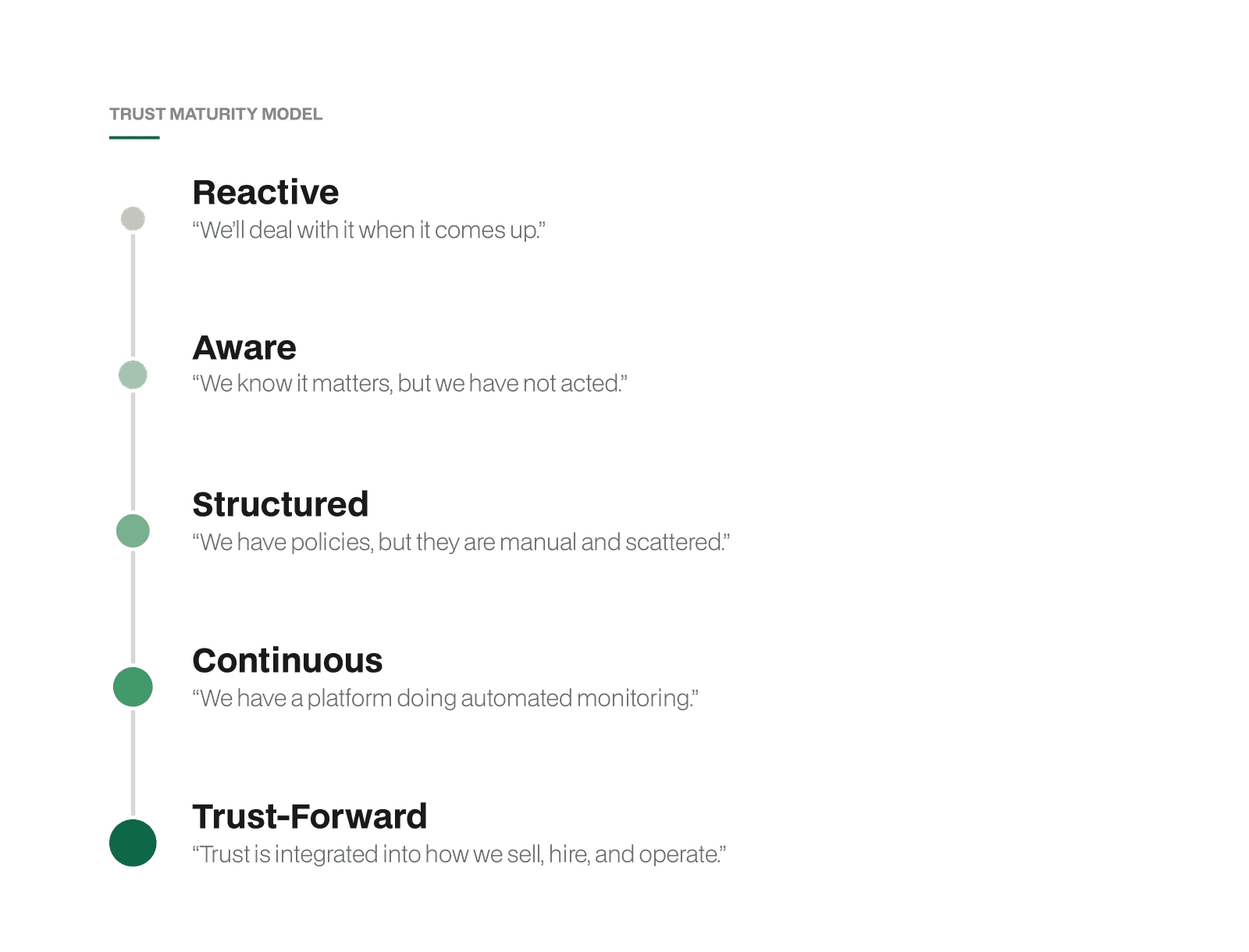
The goal for startups and scale-ups is trust-forward. The good news: modern GRC tools mean many companies can skip "structured" entirely and move straight to continuous monitoring. It is less about being perfect, and more about ensuring your compliance position today does not risk slowing your fundraising or upcoming customer conversations.
Building the Right Foundation: The Big Four
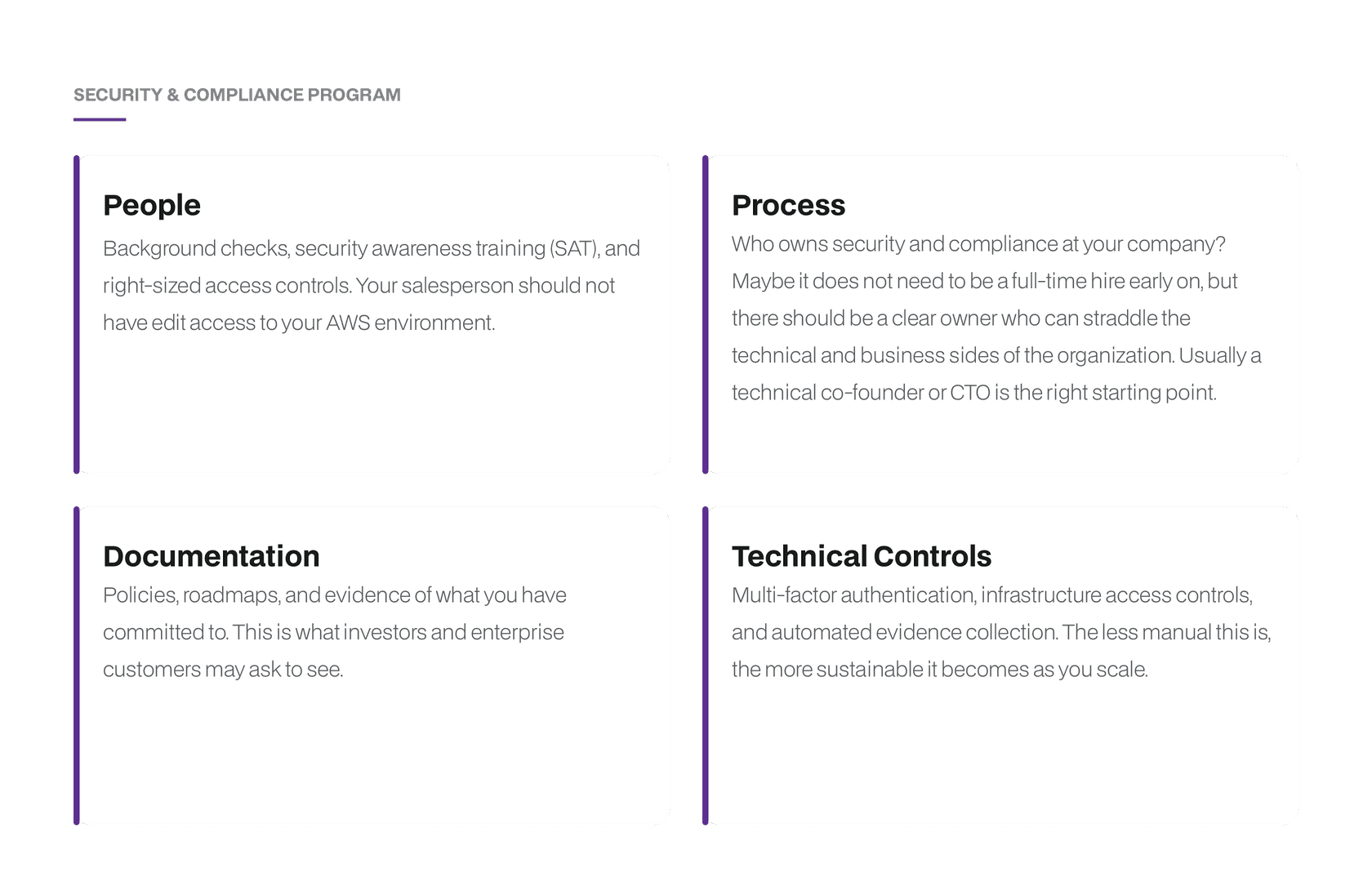
Beyond pursuing a specific framework, Kayla outlined four areas every founder should be thinking about:
Compliance as Culture, Not Just Certification
Frameworks and tools matter, but so does culture.
Melissa asked: beyond getting a compliance partner onboard, how do you actually make trust a genuine part of how a company operates?
Kayla's answer was direct: it starts with the founders.
"It has to come from leadership, from the founders on day one, who say this is going to be a priority. And then that trickles down into the culture."
This extends beyond compliance. Kayla noted that leadership alignment on trust and values has been a core reason she has stayed at Drata and believes in the mission. When employees feel that leadership is genuinely doing the right things, it shows up in retention, in recruiting, and in how teams handle pressure.
Melissa extended this further: as companies scale and bring in heads of sales, new CTOs, and other senior hires, founders need to make sure that those leaders share the same conviction. A compliance culture can't be built with a leadership team who only sees it as a box to check.
What This Means Practically
Here are the key takeaways from the session:
Move trust earlier in your roadmap. You do not need SOC 2 by tomorrow, but you should have a plan you can speak to confidently. Design partners and investors are already asking.
Connect compliance to revenue velocity. Enterprise procurement cycles are long and getting longer, especially in industries new to AI-powered software. Having your security posture in order can meaningfully shorten that cycle.
Sequence frameworks strategically. Listen to the market. If no customer is asking for ISO 27001, maybe it can wait. If you are selling into US B2B SaaS, SOC 2 is almost certainly the right first step.
Use automation as a growth lever. The days of screenshots and spreadsheets are over. This makes things easier for startups. Modern GRC platforms perform continuous monitoring and evidence collection that used to require significant engineering time.
Make it a competitive advantage. Do not hide your security posture; lead with it. When competing for an enterprise deal, being able to clearly articulate your compliance roadmap can be a differentiator.
Final Thought
As Melissa put it at the close of the session: not having a thoughtful answer around trust, security, and compliance is an inhibitor to growth. This business need does not have to feel overwhelming, and it does not need to be 100% figured out on day one. But it does need to be on the roadmap, leadership should be able to speak confidently about it, and the earlier the conversation starts, the less chaos there will be down the line.
_______
For founders in the Exceptional Capital community, visit https://try.drata.com/exceptional-capital to claim your discount or reach out to Kayla on LinkedIn or via email to get started!
This post was produced from a live session hosted by Exceptional Capital.
Kayla Anderson-Thaler leads accelerator, VC/PE and tech partnerships at Drata. With over four years in the trust management space, she has seen firsthand how security maturity impacts fundraising and growth.